Waar ben je naar op zoek?DOcume
ASICS EMEA

From Growth to Control

How Lean and digital innovation made e-commerce scalable without compromising service quality

The growth of e-commerce offers enormous opportunities, but at the same time puts pressure on organizations. Consumer expectations are rising, volumes are increasing, and processes must evolve to keep pace with this growth. For ASICS in the EMEA region, this became a crucial challenge: how do you scale up without putting pressure on service quality, efficiency, and workload?

What started as a rapidly growing e-commerce operation risked becoming bogged down in inefficiency and increasing complexity. By combining Lean thinking with digital innovation, ASICS EMEA not only managed to gain control over its operations but also laid the foundation for sustainable growth.

ASICS EMEA is the European branch of the Japanese sports brand ASICS, specializing in the development, production, and distribution of sports and running shoes, apparel, and accessories. From its European headquarters in Hoofddorp, ASICS EMEA coordinates its activities across Europe, the Middle East, and Africa. The organization focuses on delivering innovative and high-quality sports products and continuously works on optimizing its logistics processes and consumer service to meet growing demand.

Challenge

When Frederic Franzo (Manager Consumer Experience & B2C Operations EMEA) started, the e-commerce organization was still in a relatively early stage. Growth was already happening, but the processes were not yet equipped to handle it. Teams worked hard to meet demand but were constantly playing catch-up.

Processes were slow and fragmented. Consumer inquiries piled up, and the consumer service teams struggled to keep up with the volume. This led to delays and missed service levels. “We realized that we simply weren’t set up efficiently enough to support this growth,” said Frederic.

When Matías de San Félix Fitte (B2C Operations Team Lead EMEA) joined later, he observed a similar situation. The B2C operation team was still insufficiently structured to support the rapid growth of e-commerce. The lack of a clear foundation in processes and ownership made it difficult to set up and scale effectively.

The core of the challenge was clear:

  • Increasing volumes without scalable processes
  • High pressure on consumer service teams
  • Lack of standardization and visibility
  • Limited capacity for structural improvement

The urgency was growing. Continuing in the same way would mean that growth would lead to greater inefficiency, higher costs, and unsatisfactory consumer experience.

Solution

Instead of simply adding more people, ASICS EMEA chose a fundamentally different approach: working smarter through Lean.

The strength of the approach lay in the combination of two elements: training employees through Yellow and Green Belt programs and providing structured support through the Lean Center of Excellence.

On the one hand, teams were trained in Lean principles. During the Yellow and Green Belt programs, employees not only learned the theory but also immediately applied it to their own processes. This made improvement part of daily work rather than a separate initiative.

On the other hand, the Lean Center of Excellence ensured continuity and sustainability. When teams encountered challenges in practice, they could rely on support, guidance, and expertise. This made it possible not only to initiate improvements but also to implement and sustain them effectively.

This combination proved to be powerful. So far, 16 groups have participated in the training, and there is even a waiting list. Employees see the impact of Lean in their daily work and become so enthusiastic that they want to contribute to improvements themselves.

An important part of this approach was the Green Belt project led by Matías and Frederic: “Kakushin’’ (Japanese for innovation). This project focused on four pillars:

  • Operational efficiency
  • Workforce scalability
  • Service quality
  • Employee engagement

Under the guidance of our trainer Franc, the teams were supported in applying Lean to their own day-to-day work. He helped them not only to use the tools but, more importantly, to learn to view processes and problems from a different perspective.

As Franc puts it:
“The power doesn’t lie in the tools, but in the thinking. Once teams start identifying waste themselves and taking ownership, real, sustainable improvement happens.”

A concrete example was evolving Akira, our 4-year-old AI assistant on Asics.com, to a more powerful technology. Where consumer inquiries were previously handled largely manually, a significant portion of these interactions was automated.

“By applying Lean to real challenges, solutions were created that had an immediate impact,” says Matías. “It wasn’t just about improving, it was about making our operation future-proof.”

Result

The impact of the program was both immediate and lasting. The digital agent has evolved from a valuable support tool to an even more powerful and essential part of their operations since transitioning to the new technology offered by Agentforce, Salesforce AI driven Agent solution. While initially 43% of consumer inquiries were resolved automatically, this has now increased to around 66%. This means that the majority of inquiries received through chat are handled entirely without human intervention.

The effect:

  • Significantly improved efficiency
  • Scalable operation without the need for additional resources.
  • Faster response times for consumers
  • Agents now have more time to concentrate on more complex queries

In addition, the ways of working also changed. Teams are now thinking systematically about improvements, taking ownership, and using data to support their decisions. The Lean Center of Excellence promotes these ways of working so that Lean is being applied across the organization and scaled further.

Frederic sums it up perfectly:
“By combining Lean and innovation, we can accommodate growth without compromising on quality. That brings both peace of mind and confidence about the future.”

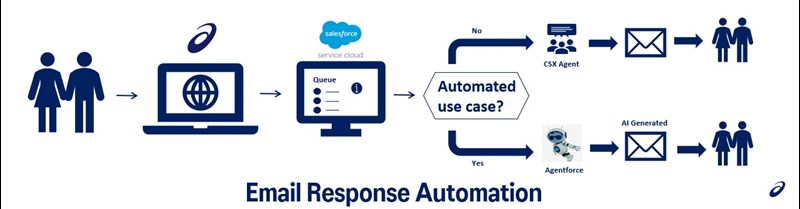
ASICS’ experience shows that growth only becomes truly valuable when processes keep pace. Not by working harder, but by organizing smarter and continuously improving. Following this Kaizen mentality, Frederic and Matías are now working on implementing the second phase of their Lean 6 Sigma Green Belt project: Email Response Automation through AI, brining enhanced scalability to ASICS EMEA Consumer Experience Operations.

For organizations facing growing consumer demand, digitalization, and increasing complexity, this is familiar. The question is not whether you need to change, but how strategic changes can be efficiently implemented.

As Franc aptly concludes:
“Lean often starts with improving processes, but it ends with changing the way people think and collaborate. That’s when growth truly becomes scalable.”

Benieuwd welke processen jij kunt doorbreken?

Wij leveren maatwerk gericht op resultaat, in alle lagen van de organisatie. Ik ga graag vrijblijvend met jou in gesprek!

Contact
Franc
Damhuis
Trainer & Consultant